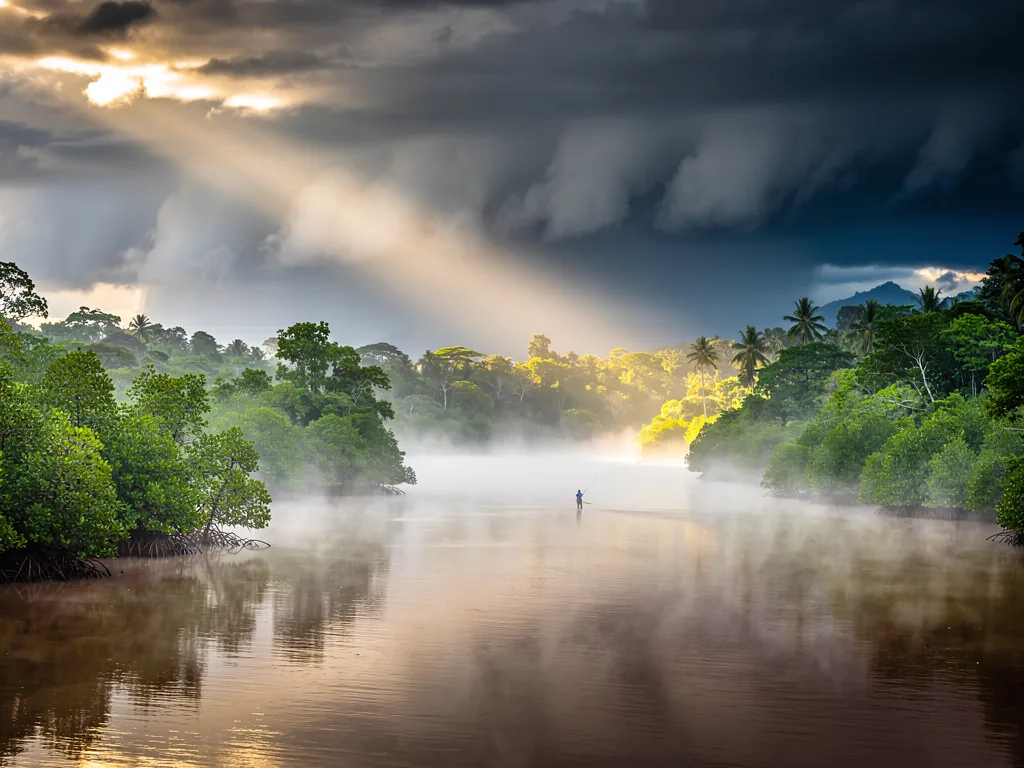
Imagine casting a surface popper into an emerald river mouth surrounded by dense jungle, when a fish strikes so violently it nearly pulls the rod from your hands. Welcome to Papua New Guinea — one of the last truly untapped fishing frontiers on Earth. From meter-long Barramundi in the wild south to the legendary Papuan Black Bass that anglers call the "River Tiger," fishing in Papua New Guinea delivers experiences that simply do not exist anywhere else.
This guide covers everything you need: licenses (or the lack thereof), the best fishing destinations, guided tours, species, techniques, travel logistics, and practical tips for international anglers planning the trip of a lifetime.
01Fishing Licenses and Permits in Papua New Guinea
Great News: No Recreational Fishing License Required
The most important thing to know before packing your rods: you do not need a fishing license for recreational or sport fishing in Papua New Guinea. The *Fisheries Management Act 1998* (Section 3(2)) explicitly exempts sport and personal-consumption fishing from licensing requirements:
*"Unless otherwise specified, the provisions of this Act do not apply to or in relation to the taking of fish – (a) for personal consumption, and not for sale or trading or for manufacturing purposes; or (b) for sport or pleasure; or (c) by customary fishing; or (d) by artisanal fishing."*
This means you are free to:
Commercial Licenses (Only for Commercial Operators)
If you are planning a commercial venture, licenses are mandatory and issued by the NFA through their Electronic Licensing System (FIMS). Fees are substantial:
| License Type | Fee (PGK) | Fee (EUR ≈) | Fee (USD ≈) |
|---|---|---|---|
| Vessel < 10 m (domestic) | 100/year | ~€20 | ~$25 |
| Vessel < 10 m (foreign local) | 500/year | ~€100 | ~$130 |
| Vessel < 10 m (foreign) | 1,000/year | ~€200 | ~$260 |
| Vessel > 50 m (domestic) | 3,500/year | ~€700 | ~$900 |
| Vessel > 50 m (foreign) | 4,500/year | ~€900 | ~$1,160 |
| Aquaculture | 500/year | ~€100 | ~$130 |
| Fish export license | 1,000/company | ~€200 | ~$260 |
| Application fee (non-refundable) | 100 | ~€20 | ~$25 |
*Exchange rates: 1 PGK ≈ 0.20 EUR ≈ 0.26 USD (mid-2025)*
Important for foreign operators: Fish buyer licenses are only issued to PNG citizens. Foreign fishing vessels require an Access Agreement and must operate through a PNG-based agent. Contact the National Fisheries Authority for details.
Tip: Even though no recreational license is required, you must obtain permission from traditional landowners before fishing in coastal waters or rivers. Your lodge or charter operator normally arranges this — but always confirm.
02Fishing Regulations and Restrictions
While no license is needed for sport fishing, certain rules still apply. Violations carry severe penalties — up to 100,000 PGK (~€20,000 / ~$26,000) for individuals and 200,000 PGK (~€40,000 / ~$52,000) for companies.
Prohibited Practices
Protected Species
PNG has strong protections for several marine species. Do not target or possess:
Customary Fishing Rights — Crucial to Understand
This is perhaps the most important regulatory concept for visiting anglers: 97% of land and inshore waters in PNG are under customary (traditional) ownership by clans and tribes. The *Customs Recognition Act (1963)* formally recognizes these rights.
What this means in practice:
03Top Fishing Destinations in Papua New Guinea
This is where Papua New Guinea truly shines. These are not your average fishing spots — they are wild, remote, and absolutely world-class.
1. Bensbach River — The Barramundi Capital of the World
| | |
|---|---|
| Water type | River and floodplains |
| Target species | Giant Barramundi (1 m+), Saratoga, Salmon fish |
| Best technique | Spin fishing (hard and soft plastics), fly fishing |
| Season | June – October |
| Highlight | More meter-long Barramundi per week than anywhere on Earth |
The Bensbach River sits in PNG's Western Province near the border with West Papua (Indonesia). It is legendary. The Bensbach Wilderness Lodge reports an average of 20 "meter-plus" Barramundi per week — a statistic that is almost incomprehensible for Barramundi anglers used to chasing that milestone for years in Australia.
The landscape is cinematic: vast grassland floodplains stretching to the horizon, populated by Rusa deer, wallabies, Jabiru storks, and saltwater crocodiles. You fish from small boats along the river's snag-filled edges, casting tight to timber where monster Barramundi ambush prey. When a 30 kg Barramundi inhales your lure next to a submerged log and powers back into the timber, you will understand why anglers travel to the ends of the Earth to be here.
2. Milne Bay & Trobriand Islands — Popper and Jig Paradise
| | |
|---|---|
| Water type | Reef, sand flats, atolls, deep sea |
| Target species | Giant Trevally (GT), Dogtooth Tuna, Napoleon Wrasse, Yellowfin Tuna |
| Best technique | Popping, jigging, trolling |
| Season | Year-round (December – April: peak GT season; June – November: calmer seas) |
| Highlight | Virtually unfished reefs in the Coral Triangle — liveaboard only |
Milne Bay offers some of the finest popper and jig fishing on the planet. The reefs around Wari Long Reef and the Trobriand Islands are only accessible by mothership — which means they see almost zero fishing pressure. This is the Coral Triangle at its rawest: you cast big poppers into the blue edge of a reef, and the explosion when a 60 kg GT inhales your lure is something you will never forget.
Below the surface, the jigging is equally extraordinary. Dogtooth Tuna exceeding 100 kg patrol the deep drop-offs, and dropping a 300 g jig to 300 m and winding for dear life is a test of endurance that few fisheries can match.
3. West New Britain / Kandrian — Home of the Papuan Black Bass
| | |
|---|---|
| Water type | Jungle rivers, estuaries |
| Target species | Papuan Black Bass (Niugini), Spottail Bass, Mangrove Jack |
| Best technique | Lure casting, fly fishing |
| Season | April – August (optimal river levels) |
| Highlight | The strongest freshwater sport fish in the world — endemic to PNG! |
The Papuan Black Bass is the ultimate river predator. Known locally as "Niugini" and dubbed the "River Tiger," this fish is endemic to Papua New Guinea — it exists nowhere else on Earth. Anglers who have caught both Black Bass and Peacock Bass consistently rate the Black Bass as the harder fighter. It is brutal, unforgiving, and will destroy undersized gear without hesitation.
Fishing for Black Bass means casting large crankbaits and soft plastics into the snag-filled jungle rivers of West New Britain. When a 20 kg Black Bass hits, it heads straight for the nearest timber, and if your drag is not locked down and your rod not buried in the gunwale, you will lose the fish — and probably your lure. Baia Sportfishing Lodge is the primary gateway, with access to five river systems.
4. Madang / Bismarck Sea — Big Game Fishing Capital
| | |
|---|---|
| Water type | Coastal waters, deep sea |
| Target species | Blue and Black Marlin, Sailfish, Dogtooth Tuna, Mahi-Mahi, Wahoo |
| Best technique | Trolling, popping, fly fishing |
| Season | Year-round |
| Highlight | Sailfish hunting in packs — a worldwide phenomenon unique to this area |
The coastal currents around Madang reach 5 knots and push pelagic species to within 100 m of shore. This means you spend less time running and more time fishing. The Sailfish here behave unlike anywhere else — they hunt in coordinated packs, herding baitfish to the surface in spectacular feeding frenzies. Seeing a dozen Sailfish crashing through a bait ball while you troll a spread of lures through the chaos is pure adrenaline.
Blue and Black Marlin are present year-round, and the Bismarck Sea has produced granders (Marlin over 1,000 lbs / 450 kg). Reel Fish Charters operating the MV "Talio" offers professional big-game trips out of Madang.
5. New Ireland / Kavieng — Blue Water and Reef Edge Fishing
| | |
|---|---|
| Water type | Reef edges, passages, deep sea |
| Target species | Dogtooth Tuna, GT, Spanish Mackerel, Wahoo, Sailfish |
| Best technique | Jigging, popping, trolling |
| Season | April – May, August – September |
| Highlight | Access to remote reefs via the PNG Explorer liveaboard |
Kavieng, on the northern tip of New Ireland, is the departure point for the PNG Explorer liveaboard. The reef edges and passages between the islands are rich with pelagic species, and the remoteness means light fishing pressure. This is a destination for anglers who want to combine blue-water trolling with reef-edge popping and deep jigging in a single trip.
🎣 Fishing tours in Papua New Guinea — Book guided fishing tours with local experts.
04Guided Tours and Charter Experiences
Papua New Guinea is not a do-it-yourself fishing destination. The remoteness, traditional land ownership, and limited infrastructure mean that nearly all visiting anglers use organized tours. This is actually an advantage — the operators here are world-class and handle all logistics.
Liveaboard Popper & Jig Trips
Liveaboards are the gold standard for PNG saltwater fishing, giving you access to reefs that are simply unreachable from land-based operations.
| Operator | Base | Price Range | Details |
|---|---|---|---|
| Sportfishing PNG (MV K20) | Alotau / Milne Bay | ~€4,000–6,000/week | Luxury mothership, 6 fishing days, max 10 anglers |
| PNG Surfaris (PNG Explorer) | Kavieng | On request | 10 days/9 nights, all-inclusive, equipment available |
| Fishabout Tours (Ultimate One) | Kimbe / West New Britain | From 9,800 AUD pp (~€5,800 / ~$6,400) | 6 days/7 nights, luxury mothership, Black Bass & bluewater |
| Rock Expeditions | Western / Gulf Province | On request (premium) | Wild-camp format, Papuan Black Bass, 10-day expeditions |
Lodge-Based Fishing
For anglers who prefer solid ground under their feet at night, these lodges offer excellent fishing with comfortable accommodations:
| Lodge | Location | Price | Duration | Included |
|---|---|---|---|---|
| Bensbach Wilderness Lodge | Western Province | From 11,650 AUD pp (~€6,900 / ~$7,600) | 6.5 fishing days | Flights ex Cairns, accommodation, meals, guided fishing |
| Baia Sportfishing Lodge | West New Britain | From $5,200 pp (~€4,800) | 8 days / 5 fishing days | Transfers, accommodation, meals, 5 guided days, loan rods |
| Liamo Reef Resort | Kimbe Bay | On request | Flexible | Resort base, day trip charters available |
Tip: Bensbach Wilderness Lodge packages include charter flights from Cairns, Australia — this is the easiest way to access the Western Province. Baia Sportfishing Lodge includes loan rods, which is helpful if you want to travel light (though bringing your own gear is always recommended).
Day Charter Boats
| Operator | Location | Contact |
|---|---|---|
| Reel Fish Charters (MV Talio) | Madang | +675 853 7496 |
| Port Moresby Game Fishing Club | Port Moresby | Gantry, Boroko |
| Boroko Sports Fishing Club | Port Moresby | +675 323 5513 |
| Madang Game Fishing Club | Madang | Via GFA PNG |
🚤 Charter fishing in Papua New Guinea — Find and book charter boats with experienced captains.
05Fish Species and Techniques
Freshwater — The Endemic Giants
| Species | Max Weight | Technique | Best Season | Notes |
|---|---|---|---|---|
| Papuan Black Bass | 25+ kg | Lure casting, fly | Apr – Aug | Strongest freshwater sport fish on Earth — endemic! |
| Spottail Bass | 15 kg | Lure casting, fly | Apr – Aug | Equally aggressive as Black Bass |
| Barramundi | 30+ kg | Spin, fly | Jun – Oct | Bensbach — world's best fishery |
| Saratoga | 5 kg | Fly fishing, surface lures | Jun – Oct | Like a prehistoric living fossil |
| Mangrove Jack | 8 kg | Lure casting | Year-round | Structure-holding predator |
Saltwater — Blue Water and Reef
| Species | Max Weight | Technique | Best Season |
|---|---|---|---|
| Giant Trevally (GT) | 80 kg | Popping, stickbait | Dec – Apr |
| Dogtooth Tuna | 100+ kg | Jigging (200–350 m!) | Dec – Apr |
| Blue Marlin | 400+ kg | Trolling | Year-round |
| Black Marlin | 500+ kg | Trolling | Year-round |
| Sailfish | 100 kg | Trolling, fly | Year-round |
| Yellowfin Tuna | 60 kg | Jigging, trolling | Dec – Apr |
| Wahoo | 40 kg | Trolling | Year-round |
| Napoleon Wrasse | 40 kg | Popping, jigging | Dec – Apr |
| Coral Trout | 15 kg | Lure casting | Year-round |
Recommended Gear
🛒 Fishing equipment for Papua New Guinea — Find the right gear for your trip.
06Best Time to Visit
Papua New Guinea's seasons vary significantly by region, so your ideal timing depends on what you want to catch:
| Region | Best Time | Reason |
|---|---|---|
| Western Province (Bensbach) | June – October | Lowest rivers, best Barramundi access |
| West New Britain (Black Bass) | April – August | Optimal river levels, better visibility |
| Milne Bay (Bluewater) | December – April | Peak GT and Dogtooth season |
| Milne Bay (Black Bass) | June – November | Rivers at their lowest |
| Madang (Big Game) | Year-round | Coastal currents bring pelagics close |
| New Ireland | April – May, August – September | Calm seas, good visibility |
For travelers from the Northern Hemisphere: June through October (PNG's dry season) aligns with European and North American summer — ideal for planning your trip during your holiday season.
For travelers from the Southern Hemisphere: The same June–October window is the Australian/New Zealand winter, making it a perfect escape to tropical fishing.
07Practical Travel Information
Getting There
Visa Requirements
Papua New Guinea offers several entry options for tourists:
Tip: Apply for your eVisa at least 2 weeks before travel to allow for any processing delays. Have your passport, itinerary, and accommodation details ready.
Health and Safety
Language
- "Gude" — Hello
- "Tenkyu" — Thank you
- "Kaikai" — Food/eating
- "Pis" — Fish
- "Wanem nem bilong yu?" — What is your name?
Money and Connectivity
📱 Stay connected in Papua New Guinea — Get an eSIM for affordable mobile data while traveling.
### Getting Around
🚗 Rent a car in Papua New Guinea — Compare prices from 500+ rental companies worldwide.
### Equipment Checklist
| Item | Bring from Home | Available Locally |
|---|---|---|
| Rods and reels | ✅ Essential | ❌ Limited/none |
| Lures and jigs | ✅ Bring plenty | ⚠️ Expensive if available |
| Braided line and leader | ✅ Essential | ❌ Unreliable supply |
| Sunscreen (reef-safe) | ✅ Recommended | ⚠️ Limited |
| Insect repellent (DEET) | ✅ Essential | ⚠️ Limited |
| Light rain jacket | ✅ Recommended | ❌ |
| Power adapter (AU plug) | ✅ Essential | ⚠️ |
08Legal Notes for International Anglers
Importing Fishing Equipment
Personal fishing gear can be imported without any special permit. For firearms (hunting), a license is required and must be arranged through your lodge at least one month in advance.
Exporting Your Catch
Customary Rights Reminder
Always remember: nearly all coastal and riverine waters in PNG belong to traditional owners. Fishing without permission is not just illegal — it is deeply disrespectful. Your lodge, charter, or guide will arrange permissions, but it is wise to confirm this is included in your package.
09Cost Overview
| Expense | Approximate Cost | Notes |
|---|---|---|
| eVisa | $50 USD (~€46) | Online application |
| Domestic flight (Port Moresby to Daru/Madang/Kimbe) | 400–800 PGK (~€80–160) | One way |
| Liveaboard (7 days) | €4,000–6,000 pp | All-inclusive |
| Lodge package (5–7 fishing days) | €4,800–7,000 pp | Most inclusive |
| Day charter (Madang) | On request | Contact operator |
| Meals in Port Moresby | 30–60 PGK (~€6–12) | Restaurant meal |
| Malaria prophylaxis | Varies by country | Consult your doctor |
For perspective, a week-long liveaboard in PNG costs roughly the same as a similar trip in the Maldives or Seychelles — but with far less fishing pressure and the chance at species found nowhere else.
10FAQ
Do I need a fishing license in Papua New Guinea?
No. Recreational and sport fishing is explicitly exempt from licensing under the Fisheries Management Act 1998. You can fish freely for sport or personal consumption. Only commercial fishing requires a license from the National Fisheries Authority.
What is the Papuan Black Bass?
The Papuan Black Bass (Niugini) is a freshwater sport fish endemic to Papua New Guinea — it exists nowhere else on Earth. It is widely regarded as the strongest freshwater sport fish in the world, known for brutal strikes and unstoppable runs into submerged timber. It can exceed 25 kg.
Is it safe to travel to Papua New Guinea for fishing?
The fishing regions themselves are generally safe, as they are community-based and remote. Port Moresby has a high crime rate and requires caution. Always travel through organized tours, use local guides, and avoid walking alone at night in cities. Comprehensive travel insurance with medical evacuation is essential.
When is the best time to fish in Papua New Guinea?
It depends on your target: June–October for Barramundi (Bensbach), April–August for Papuan Black Bass (West New Britain), and December–April for peak GT and Dogtooth Tuna action (Milne Bay). Madang offers year-round big-game fishing.
Do I need to bring my own fishing equipment?
Yes, absolutely. Bring your own rods, reels, lures, jigs, and line. While some lodges (like Baia Sportfishing) offer loan rods, the selection is limited and you should not rely on lodge gear for a trip of this caliber. Lures are expensive and scarce in PNG — bring plenty.
Can I fish independently without a guide?
Technically yes, in areas where you have landowner permission. Practically, it is extremely difficult. PNG's rugged terrain, limited roads, traditional land ownership, and complex logistics make independent fishing nearly impossible for visitors. Using a lodge or charter is strongly recommended.
How do I get to the fishing spots?
Almost all fishing destinations are reached by domestic flights from Port Moresby, followed by boat transfers. Some lodges (like Bensbach) include charter flights from Cairns, Australia in their packages. Roads between provinces are generally not viable for travelers.
What about malaria?
Papua New Guinea is a malaria-endemic country. Malaria prophylaxis is strongly recommended. Consult a travel medicine specialist at least 4–6 weeks before departure. Also bring DEET-based insect repellent and wear long-sleeved clothing during dawn and dusk.
11Conclusion
Papua New Guinea is fishing's last great frontier. Nowhere else can you cast for meter-long Barramundi in wild jungle rivers, battle a Papuan Black Bass that will test every ounce of your skill and equipment, and pop for Giant Trevally over reefs that see almost zero fishing pressure — all in the same country. The fact that no recreational fishing license is required is simply the cherry on top.
This is not an easy destination. It demands preparation, respect for local customs, and a willingness to venture far from the familiar. But for anglers who make the journey, Papua New Guinea delivers stories that no other fishery on Earth can match.
Start planning your Papua New Guinea fishing adventure today — and prepare for the trip of a lifetime.
12Sources and Further Links
*Disclaimer: All information in this article is provided for general guidance only and is current as of 2026. Regulations, fees, visa requirements, and health advisories may change at any time. Always verify current requirements with the relevant official authorities (National Fisheries Authority, Immigration & Citizenship Authority of PNG, and your country's travel advisory service) before planning your trip. Fishing World Guide accepts no liability for decisions made based on this information.*
Don't miss any fishing tips!
Get the best fishing destination recommendations weekly in your inbox.
No spam. Unsubscribe anytime.
Read more
Data incorrect?
Help us keep this article up to date — report outdated or incorrect information
More articles