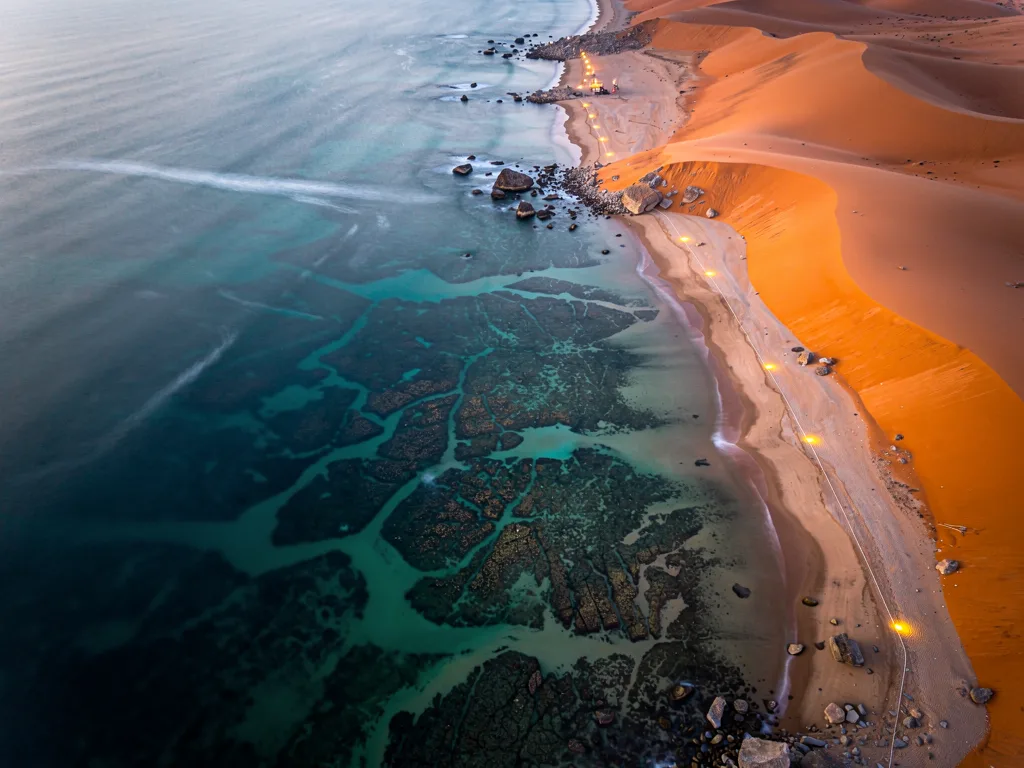
Namibia offers one of the most diverse and dramatic fishing experiences on the African continent. From casting heavy surf rods into the crashing waves of the Skeleton Coast in pursuit of massive kob and steenbras, to battling explosive tigerfish on the Zambezi River, this desert-meets-wilderness country is a true bucket-list destination for international anglers.
Whether you dream of landing a 100 kg bronze whaler shark from a 4x4 on an empty beach or sight-fishing for hard-fighting nembwe in the clear waters of the Kavango, fishing in Namibia delivers adventure, solitude, and world-class sport. In this comprehensive guide, you will find everything you need to plan your trip successfully: how to obtain the mandatory fishing permit, the best fishing spots, guided tours and charters, current regulations, costs in NAD, EUR and USD, and practical travel information for visitors from Europe, North America, Asia and beyond.
Namibia’s two distinct fishing zones — the cold, nutrient-rich Atlantic coast and the warm, tropical inland river systems — mean you can combine a coastal surf-fishing safari with a tigerfish expedition in a single two-week trip. Regulations are strictly enforced to protect fish stocks, but permits remain remarkably affordable. This guide is based on the latest official information from the Ministry of Fisheries and Marine Resources (MFMR) and will help you fish responsibly and legally.
01Do You Need a Fishing License in Namibia?
Yes — you must have a valid recreational fishing permit for every form of angling in Namibia, whether you fish from the shore, a boat, a kayak, or inland rivers and dams. There is no exemption for tourists or short-term visitors. Attempting to fish without a permit can result in heavy fines, confiscation of equipment, and even criminal charges.
Namibia maintains separate permits for marine (sea) fishing and inland (freshwater) fishing. A marine permit does not allow you to fish the Zambezi or Kavango rivers, and vice versa. This system protects both the Atlantic fish stocks and the unique freshwater species of the north-eastern Caprivi and Kavango regions.
Permits are not available online. You must apply in person and present a valid passport or national ID. Children under 18 require a birth certificate. Processing is usually immediate, but plan to visit one of the designated offices upon arrival in Windhoek, Swakopmund, Walvis Bay, Lüderitz or Henties Bay.
Tip: If you are flying into Hosea Kutako International Airport in Windhoek, obtain your permit at the MFMR headquarters in Brendan Simbwaye Square before heading to the coast or the Zambezi Region. This saves time and ensures you are legal from day one.
Types of Permits and Current Costs (2026)
After a short-lived attempt to dramatically increase fees in 2017, the Namibian government reverted to long-standing affordable rates that remain in effect today. These prices make a fishing holiday in Namibia accessible even for budget-conscious international travelers.
Marine (Sea) Fishing Permits:
Freshwater (Inland) Fishing Permits for non-Namibians:
These fees are roughly the cost of a cup of coffee or a simple restaurant meal in Europe or North America, making Namibia one of the most affordable premium fishing destinations worldwide.
For the absolute latest fees, always check directly with the Ministry of Fisheries and Marine Resources before travel, as minor administrative adjustments can occur.
02Fishing Regulations and Bag Limits in Namibia
Namibia enforces strict conservation measures under the Marine Resources Act 27 of 2000 and the Inland Fisheries Resources Act 1 of 2003. The goal is to prevent over-exploitation while allowing sustainable recreational angling.
Marine Bag and Size Limits
Minimum size limits (marine):
Prohibited Practices
Freshwater Regulations
In the Zambezi, Kavango and Orange River systems, different limits apply. Tigerfish, nembwe, tilapia and yellowfish all have specific protection rules. The Inland Fisheries Resources Regulations 2003 detail exact bag limits and closed seasons for certain areas. Always obtain the latest printed regulations when you purchase your freshwater permit.
Important note: Regulations can change. The information above is current as of early 2026, but you should always consult the official MFMR brochure or website before fishing. Ignorance is not accepted as a defense.
03Best Fishing Spots in Namibia – Where to Make Your Dreams Come True
The contrasting landscapes of Namibia create two entirely different fishing worlds that together make this country unforgettable.
1. Henties Bay – The Mecca of Shore Angling
Henties Bay (often simply called “Henties”) is the most famous coastal angling town in Namibia. Here you can drive your 4x4 directly onto the endless sandy beaches and set up camp for days. The cold Benguela Current brings nutrient-rich upwellings that attract huge schools of kob (kabeljou), west coast steenbras, galjoen and blacktail.
Many anglers consider landing a 20–30 kg kob from the surf here the pinnacle of Namibian coastal fishing. The experience of standing on an empty beach with only the sound of waves and the occasional seal is pure magic. At night, camping under the southern stars while your bait rods are set for big kob creates memories that last a lifetime.
2. Zambezi River (Caprivi / Zambezi Region) – Tigerfish Paradise
In the lush, tropical north-east, the Zambezi River near Katima Mulilo offers spectacular tigerfish action. These “Tigers of the Zambezi” are renowned for their spectacular jumps, razor-sharp teeth and brutal fights. An average fish is 3–6 kg, but specimens over 10 kg are possible.
The scenery is pure Africa: papyrus-lined channels, elephants drinking at the river’s edge, hippos grunting, and fish eagles overhead. Drifting live “bulldog” bait or casting Rapala-style lures near structure produces heart-stopping strikes. Many lodges offer skiff boats with experienced local guides who know exactly where the tigers are holding.
3. Skeleton Coast – Remote Wilderness Fishing
Further north along the Skeleton Coast, the fishing becomes increasingly remote and wild. Massive bronze whaler sharks (up to 180 kg) patrol these waters and must be strictly catch-and-release. The chance to fish where few others venture, surrounded by desert dunes meeting the Atlantic, is an experience few anglers ever forget.
4. Kavango River around Rundu
The Kavango River offers superb fishing for predatory nembwe (a type of bream) and three-spot tilapia. This area is particularly popular with fly-fishing enthusiasts. The combination of sight-fishing in clear, shallow bays and the possibility of seeing wildlife makes this a very special destination.
5. Orange River (Southern Namibia)
On the border with South Africa, the Orange River offers excellent fishing for large common carp and yellowfish. Many visitors combine a kayaking or rafting safari with fly fishing in the rapids. The dramatic desert canyon scenery provides a spectacular backdrop.
Each of these locations offers a completely different fishing experience — from the wild surf of the Atlantic to the jungle rivers of the north. Many international visitors spend one week on the coast and one week in the Zambezi Region to enjoy the full spectrum of fishing in Namibia.
Tip: The contrast between the arid Skeleton Coast and the lush Zambezi floodplains is one of the most striking features of a Namibia fishing trip. Planning a multi-region itinerary will give you the richest possible experience.
04Tours & Guided Experiences – Book Your Namibia Fishing Adventure
While self-guided fishing is possible and popular, many international visitors prefer to book guided tours, especially for their first trip. Professional guides know the ever-changing conditions, best bait, and productive spots, dramatically increasing your chances of success.
Deep-sea charters operate mainly out of Walvis Bay and Swakopmund. These trips typically target snoek, kob, and various bottom species. Prices range from €80 to €150 per person (approx. N$1,600–N$3,000 / US$90–US$170), usually including tackle, bait, lunch and transfer from your accommodation. A full day on the water (8–10 hours) offers excellent value.
Shark angling tours from Henties Bay use 4x4 vehicles to access remote beaches. These specialist guides provide heavy tackle suitable for bronze whalers up to 180 kg. Expect to pay €120–€200 per person for a full day, including all equipment and conservation-focused handling practices (most sharks are released).
In the Zambezi Region, specialized tigerfish lodges such as Zambezi Mubala Lodge, Kalizo Lodge and others offer all-inclusive guided boat packages. A typical rate is around €200 per night (approx. N$4,000 / US$225) per person, including accommodation, all meals, guided fishing, boat, fuel and tackle. Multi-night packages often provide better value and allow you to explore different stretches of the river.
Many operators also offer combined activities — tigerfishing in the morning followed by a game drive or birdwatching in the afternoon.
🎣 Fishing tours in Namibia — Book guided fishing tours with local experts.
🚤 Charter fishing in Namibia — Find and book charter boats with experienced captains.
05Popular Fish Species and Proven Techniques
Sea Kob (Kabeljou): The most sought-after surf species. Use fresh pilchard (sardine) or chokka (squid) on circle hooks with a strong sliding sinker rig. Best fished on the incoming tide.
Tigerfish: Require wire traces because of their incredible teeth. Effective techniques include trolling with large spoons, casting Rapala-type lures, or drifting live “bulldog” (a small catfish-like baitfish). Their explosive surface strikes are legendary.
Bronze Whaler Sharks: These are apex predators and world-class sport fish. Heavy tackle (80–130 lb class) with large fresh fish baits is essential. All sharks should be released to maintain healthy populations.
Nembwe and Tilapia: Excellent sport on lighter tackle and fly gear. Sight fishing in the shallow bays of the Kavango River can be incredibly rewarding.
Yellowfish on the Orange River: Strong fighters that respond well to nymphs and dry flies in the rapids.
06Equipment Recommendations for Namibia
For the coast, bring or rent heavy surf rods of 12–14 ft (3.6–4.2 m) capable of casting 150–200 g sinkers into strong surf. Durable reels with high line capacity (30–50 lb braid) are essential. A 4x4 vehicle is almost mandatory for accessing the best beaches.
In the Zambezi and Kavango rivers, medium-heavy spinning or baitcasting outfits (20–40 lb class) work well for tigerfish. Fly fishers should bring 8–10 wt rods for the larger rivers.
Most lodges in the north rent quality freshwater equipment, but serious coastal anglers usually prefer to bring their own surf gear. Pack polarized sunglasses, sunscreen, a wide-brimmed hat, and insect repellent for the river regions.
🛒 Fishing equipment for Namibia — Find the right gear for your trip.
07Practical Travel Information for International Visitors
Best time to visit:
Visa requirements: Citizens of most EU countries, the United States, United Kingdom, Canada, Australia, New Zealand, Japan and many others receive a free visa on arrival valid for 90 days. South African citizens do not need a visa. Always check the latest requirements for your nationality before travel.
Getting there and around: Most international visitors fly into Windhoek (WDH). From there, you can rent a 4x4 for self-drive adventures or arrange transfers to the coast (approx. 4 hours to Swakopmund) or fly to the Zambezi Region. A sturdy 4x4 is highly recommended for coastal angling.
Language: English is the official language. Afrikaans and German are widely spoken, especially in the fishing communities along the coast. In the Zambezi Region, local languages (Lozi, Mbukushu) are common, but lodge staff and guides speak excellent English. Translation apps are rarely needed.
Health and safety: Namibia is generally very safe for tourists. Malaria is a risk in the northern river regions from November to May — take appropriate prophylaxis. Drink only bottled water in remote areas. Bring sufficient sunscreen and stay hydrated in the desert climate.
Currency and costs: The Namibian Dollar (N$) is pegged 1:1 to the South African Rand. ATMs are available in major towns. Most fishing-related expenses are very reasonable compared to other African safari destinations.
📱 Stay connected in Namibia — Get an eSIM for affordable mobile data while traveling.
🚗 Rent a car in Namibia — Compare prices from 500+ rental companies worldwide.
08Catch Export and Transport Rules
You may transport a maximum of 30 fish (equivalent to three days’ bag limit) for personal use when leaving Namibia. Fish must be carried in a “whole state” (head and tail intact) so authorities can verify size and species. Gutting is permitted. When crossing into South Africa, you will also need a valid South African import permit for the fish.
09FAQ – Fishing in Namibia
Do I need a fishing license in Namibia?
Yes. Every angler, including tourists, must possess a valid recreational fishing permit for both marine and freshwater fishing. Permits are inexpensive but mandatory.
How much does a fishing permit cost in Namibia?
Marine monthly permits cost only N$ 14 (€0.70 / US$0.80). Annual permits are N$ 168 (€8.50 / US$9.50). Daily options are N$ 50 (€2.50 / US$2.80). Freshwater permits for non-residents are approximately N$ 28.40 per month.
What is the best time for tigerfish in Namibia?
The optimum period is June to December when water levels drop and conditions become clearer. September to November often provides the most consistent action.
Can I rent fishing equipment in Namibia?
Yes. Most tigerfish and river lodges provide quality freshwater tackle. Coastal surf equipment is harder to rent — serious surf anglers usually bring their own heavy rods and reels.
Is it safe to fish from the Skeleton Coast?
With a proper 4x4, appropriate safety precautions, and ideally a local guide, yes. However, the coast is extremely remote — always inform someone of your plans, carry ample water, and respect the powerful surf and currents.
Do I need a special license to catch sharks in Namibia?
Your standard recreational marine permit covers shark angling, but strict bag limits apply (usually 1 per day) and many species must be released. Specialized guides are strongly recommended.
Can I combine coastal fishing with tigerfishing in one trip?
Absolutely. Many visitors spend one week on the coast (Swakopmund/Henties Bay) and fly or drive to the Zambezi Region for the second week. This provides the perfect balance of experiences.
10Conclusion
Fishing in Namibia is far more than just catching fish — it is an unforgettable journey through dramatic desert landscapes, along wild Atlantic shores, and into the heart of tropical Africa. The combination of affordable permits, world-class sport fishing for tigerfish, kob, and sharks, and the sheer scale and beauty of the country makes it a must-visit destination for any serious angler.
Whether you choose to explore the famous shores of Henties Bay, battle tigers on the Zambezi, or venture into the remote Skeleton Coast, Namibia will reward you with memories that will last a lifetime. Plan well, obtain your permits, respect the regulations, and prepare to fall in love with one of Africa’s finest fishing destinations.
Start planning your Namibia fishing adventure today — the desert, the rivers, and the fish are waiting.
Sources & Further Links
Disclaimer: This article is intended for informational purposes only. Fishing regulations, permit prices and bag limits may change at any time. Always verify the latest rules directly with the Ministry of Fisheries and Marine Resources (MFMR) in Namibia before your trip. The authors and FishingWorldGuide.com assume no liability for any omissions, errors or changes in regulations. This guide was updated for 2026.
Don't miss any fishing tips!
Get the best fishing destination recommendations weekly in your inbox.
No spam. Unsubscribe anytime.
Data incorrect?
Help us keep this article up to date — report outdated or incorrect information
More articles