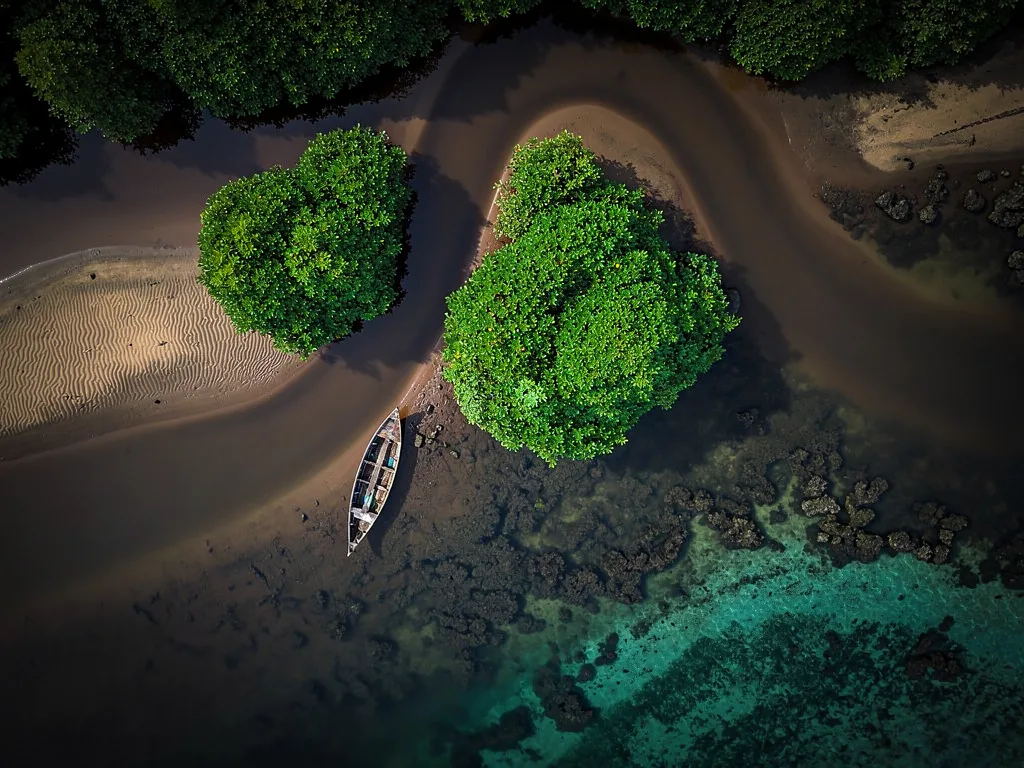
Imagine standing on the deck of a sturdy fiberglass boat as the first golden rays of sunrise touch the mangroves of the Bijagós Archipelago. Suddenly, your heavy popping rod buckles under the explosive run of a 100 kg (220 lb) silver tarpon that clears the water in a spectacular leap. This is not a fantasy — this is fishing in Guinea-Bissau, one of the last true frontiers of saltwater sport fishing in West Africa.
Guinea-Bissau offers an untouched paradise for serious anglers seeking massive Tarpon, powerful Jack Crevalle, Cubera Snapper, Barracuda, Cobia, and an astonishing variety of sharks. Protected by its UNESCO Biosphere Reserve status, the Bijagós Archipelago remains remarkably pristine compared to more commercialized African destinations. With few roads, limited infrastructure, and vast areas accessible only by boat, this destination delivers the raw, wild experience that experienced international travelers crave.
In this comprehensive guide you will discover everything needed to plan a successful trip: whether you need a fishing license in Guinea-Bissau, the best fishing spots, how to book expert charters, current costs, travel practicalities, and essential regulations including the important “biological rest” period. We address the needs of anglers arriving from Europe, North America, Asia, and beyond.
Whether you dream of world-record Tarpon in the channels of Caravela Island or jigging monster groupers around Acunda’s reefs, this guide will help you turn that dream into reality.
01Do You Need a Fishing License in Guinea-Bissau?
Yes — in almost all cases, you need a fishing permit in Guinea-Bissau for recreational or sport fishing.
According to current regulations managed by the Ministério das Pescas (Ministry of Fisheries), a recreational fishing license is strictly required for all boat-based angling, including charters and lodge-organized trips. The only exception is true subsistence fishing — that is, fishing from shore solely for personal or family consumption with no intention of selling the catch. Shore-based sport fishing without selling the catch is generally free and does not require a license under Decree 4/96, though this applies mainly to local artisanal practices rather than visiting tourists who typically fish from boats.
Most international visitors obtain their fishing license Guinea-Bissau through their chosen lodge or tour operator. Operators such as Acunda Lodge, Kasa Afrikana, Atlantic Evasion, and Africa Princess handle the paperwork as part of the package. This removes the burden of navigating bureaucracy in Bissau and ensures compliance with both national and protected-area rules.
License costs currently run between €45 and €50 (approximately 30,000–33,000 XOF or $49–$55 USD). These are typically issued for the exact duration of your stay — usually one or two weeks. If you plan to fish inside national parks such as Orango National Park or João Vieira e Poilão National Park, you will also need a special park permit or daily entry fee, which adds roughly €35 per day per person.
Important Note: Always verify current requirements directly with your operator before travel. Regulations can evolve, especially regarding protected areas and the annual biological rest period.
The licensing system exists primarily to protect the remarkable biodiversity of the Bijagós, a UNESCO World Heritage site and Biosphere Reserve. By requiring permits, authorities can better monitor pressure on stocks of Tarpon, sharks, and other key species.
For travelers from the EU, US, UK, Japan, and most other countries, your lodge will usually request a copy of your passport and flight details in advance to pre-arrange the permit. This service is included in virtually all quality fishing packages.
02Fishing Regulations and Important Rules
Guinea-Bissau maintains a clear distinction between commercial, artisanal, and recreational fishing. As a sport angler, you must observe several key rules:
These regulations reflect Guinea-Bissau’s commitment to sustainable use of its rich marine resources. The country’s relatively low tourism volume has helped preserve fish stocks that have declined in more heavily fished neighboring waters.
03Best Fishing Spots in Guinea-Bissau
The heart of sport fishing in Guinea-Bissau beats in the Bijagós Archipelago — a maze of 88 islands and countless channels, mangroves, reefs, and open ocean drop-offs. Here are the premier destinations that make anglers return year after year.
Acunda Island
Located on the western edge of the archipelago, this private islet is widely regarded as a jigging paradise. Deep channels, rocky drop-offs, and strong currents attract Cubera Snapper, Giant Trevally, and various groupers. The surrounding waters also produce explosive surface action with Jacks and Cobia. Acunda Lodge sits directly on the island, giving guests immediate access to prime grounds without long daily transits.
Orango National Park
Famous for its resident “saltwater hippos,” Orango offers an otherworldly fishing experience. The complex channels between Orango and Uno islands are prime territory for monster Tarpon and large sharks (Tiger, Bull, and Lemon sharks are regularly encountered). The mixture of mangrove-lined creeks and deeper oceanic waters creates a rich ecosystem that supports year-round action. Fishing here requires the additional park permit mentioned earlier.
Caravela Island
Many visiting anglers consider Caravela the single best location for world-record-class Tarpon. The combination of deep channels, strong tidal flows, and abundant baitfish produces Tarpon exceeding 100 kg (220 lb). Techniques range from live bait under balloons to heavy casting with large plugs and poppers. The island’s relative isolation adds to the sense of adventure.
Bubaque Island
As the administrative center of the Bijagós, Bubaque serves as an excellent hub. The surrounding waters offer outstanding fishing for Barracuda, various species of Jack (Crevalle, Horse-eye), African Red Snapper, and Leerfish (Goliath Tigerfish relatives). Kasa Afrikana lodge on Bubaque provides comfortable accommodation and a fleet of stable boats suitable for both inshore and offshore exploration.
Rio Grande de Buba
South of the capital Bissau lies this deep estuary system. While less visited by international sport fishers, it offers superb opportunities for Corvina (Croaker), Red Snapper, and, in the transition zone to open ocean, Atlantic Sailfish. This area is particularly attractive for anglers who combine a city stay in Bissau with boat excursions.
The biological diversity here is staggering. On a single day you might encounter Tarpon, Cubera Snapper, Giant Trevally, Cobia, Barracuda, African Threadfin, and multiple shark species — all within sight of pristine tropical islands teeming with birds, monkeys, and crocodiles.
Tip: The best fishing often occurs during the strongest tidal movements. Your guide will time departures to coincide with peak current flows around the many islands and reefs.
04Fish Species and Proven Techniques
Guinea-Bissau is home to an impressive array of trophy saltwater species:
The most productive techniques are popping and jigging rather than traditional trolling, although some operators combine both. High-quality reels with high drag capacity (at least 15–20 kg) and heavy braided line (80–130 lb test) are essential.
05Tours & Guided Experiences
Almost all successful trips to Guinea-Bissau are organized as all-inclusive fishing packages through specialist lodges and operators. Independent day charters are virtually non-existent due to the remote location and logistical challenges.
Popular operators include:
A typical 7-night, 6-day fishing package including international flights from Europe, boat transfers, full board accommodation, guiding, tackle (in some cases), and permits costs between €3,000 and €4,000 per person. This represents remarkable value when compared to similar experiences in more developed African destinations.
Smaller groups (2–4 anglers per boat) are standard, ensuring personalized service and maximum fishing time.
🎣 Fishing tours in Guinea-Bissau — Book guided fishing tours with local experts.
06Charter Fishing in Guinea-Bissau
While true “walk-on” charters are rare, several specialist operators offer dedicated charter boats as part of longer stays. The fleet consists mainly of 7–10 meter fiberglass center-consoles powered by twin outboards — ideal for navigating the shallow flats, mangrove creeks, and offshore reefs.
Experienced captains who have spent decades in the Bijagós know the complex tides, hidden reefs, and seasonal movements of fish. Many captains are also skilled at reading the water for signs of bird activity or bait balls that indicate feeding fish.
Prices for private charter days (when booked separately from packages) typically range from €450–€750 per boat per day depending on distance traveled and target species. However, most international visitors find it more practical and cost-effective to book complete lodge packages.
🚤 Charter fishing in Guinea-Bissau — Find and book charter boats with experienced captains.
07Best Time to Visit for Fishing in Guinea-Bissau
The prime fishing season runs from late October/November through mid-May, coinciding with the dry season. During these months you benefit from lower humidity, lighter winds, and more predictable weather. Water temperatures remain consistently warm (26–29°C / 79–84°F), and fish activity is high.
The rainy season (June–October) brings higher rainfall, stronger winds, and occasional rough seas that can limit access to outer islands. However, some dedicated anglers report excellent Tarpon fishing during the early weeks of the rainy season when river outflows push baitfish into the channels.
From a hemispheric perspective:
Avoid January if possible due to the biological rest period when much of the commercial and potentially recreational activity is restricted.
08Practical Travel Information
Visa Requirements
Most nationalities require a visa to enter Guinea-Bissau. Citizens of the EU, US, UK, Canada, Japan, Australia, and many others can often obtain a visa on arrival at Bissau airport (OXB) for approximately €85, though this is not guaranteed. Many lodges provide an official invitation letter that allows you to apply for an e-visa or pre-arranged visa through the nearest embassy or consulate. Always check the latest requirements 3–4 months before travel.
Getting There
International flights arrive at Osvaldo Vieira International Airport (OXB) in Bissau. Common routings include:
From Bissau, most lodges organize fast boat transfers lasting 1.5 to 3 hours depending on the destination island. Some operators offer charter flights directly to smaller airstrips on Bubaque or other islands, significantly reducing transfer time.
Health and Safety
Currency and Payments
The official currency is the West African CFA Franc (XOF). At the time of writing, €1 ≈ 656 XOF and $1 ≈ 610 XOF. Credit cards are rarely accepted outside major hotels in Bissau. Bring sufficient Euros in cash for any extras, tips, or additional permits. ATMs are limited and unreliable on the islands.
Language
The official language is Portuguese. French is also widely understood due to the proximity of francophone countries. English is spoken by most lodge staff and captains who work with international clients. Translation apps such as Google Translate (with offline Portuguese and French packs) are useful in Bissau, but unnecessary once you reach your fishing lodge.
📱 Stay connected in Guinea-Bissau — Get an eSIM for affordable mobile data while traveling.
09What to Pack and Equipment Considerations
For a successful trip to Guinea-Bissau, quality equipment is essential. Most lodges provide rods and reels suitable for the heavy fishing encountered, but many experienced anglers prefer to bring their own favorites.
Recommended tackle:
If you prefer traveling light, most operators can supply suitable tackle upon request (confirm in advance).
🛒 Fishing equipment for Guinea-Bissau — Find the right gear for your trip.
10Sample Costs Overview
| Item | Cost in XOF | Cost in EUR | Cost in USD | Notes |
|-----------------------------------|-------------------|-----------------|------------------|-------|
| Recreational Fishing License | 30,000–33,000 | €45–€50 | $49–$55 | Per trip, via lodge |
| National Park Daily Permit | ~23,000 | €35 | $38 | Per day in protected areas |
| Full 7-night Fishing Package | — | €3,000–€4,000 | $3,250–$4,350 | All-inclusive from Europe |
| Additional Charter Day | 300,000–490,000 | €450–€750 | $490–$815 | Private boat |
| Yellow Fever Vaccination | — | €60–€90 | $65–$100 | If not already vaccinated |
These packages are comparable to the cost of a good safari in East Africa but deliver an entirely different — and many say superior — fishing experience.
11Conclusion: Is Guinea-Bissau Your Next Fishing Adventure?
Fishing in Guinea-Bissau offers something increasingly rare in our modern world: authentic wilderness angling with the chance of landing fish of a lifetime in spectacular surroundings. The combination of monster Tarpon, powerful jacks, pristine islands, and a strong focus on conservation creates an experience that stays with you forever.
While the journey requires careful planning and a spirit of adventure, the rewards are extraordinary. By booking through reputable operators who handle licenses, permits, and logistics, you can focus entirely on the fishing.
Ready to experience one of Africa’s best-kept fishing secrets? Start planning your trip to the Bijagós Archipelago today. The Silver Kings are waiting.
12FAQ – Frequently Asked Questions
Do you need a fishing license in Guinea-Bissau?
Yes. All boat-based recreational fishing requires a permit issued through the Ministry of Fisheries. Most lodges arrange this for you. Shore fishing for personal consumption only is exempt.
When is the best time to fish in Guinea-Bissau?
The optimal season runs from November to mid-May. Avoid January due to the biological rest period when fishing activity is heavily restricted.
What is the cost of a fishing trip to Guinea-Bissau?
All-inclusive weekly packages typically range from €3,000 to €4,000 per person, including flights from Europe, accommodation, meals, guiding, and permits.
What is the biggest fish you can catch in Guinea-Bissau?
Tarpon over 100 kg (220 lb) are realistic. Sharks exceeding 200 kg and large Cubera Snapper are also regularly landed.
Is it safe to travel to Guinea-Bissau for fishing?
The Bijagós Archipelago is considered safe for tourists who travel with reputable operators. Follow your lodge’s advice regarding travel in Bissau itself.
Can I keep the fish I catch?
Most lodges practice strict catch-and-release, especially for Tarpon and sharks. Limited table fish may be kept for lodge meals.
What language is spoken on fishing charters?
Portuguese is the national language, but captains and guides working with international clients usually speak good English or French.
Do I need a Yellow Fever vaccination to enter Guinea-Bissau?
Yes. A valid International Certificate of Vaccination against Yellow Fever is mandatory for all travelers.
13Sources & Further Links
Disclaimer: This guide was written in 2026 based on the best available information at the time of publication. Fishing regulations, biological rest periods, permit prices, and safety situations may change. Always verify the latest requirements directly with the Ministério das Pescas, IBAP, your chosen lodge, and official government travel advisories before booking your trip to Guinea-Bissau. The authors and FishingWorldGuide.com assume no liability for any inaccuracies or changes that may occur.
Don't miss any fishing tips!
Get the best fishing destination recommendations weekly in your inbox.
No spam. Unsubscribe anytime.
Data incorrect?
Help us keep this article up to date — report outdated or incorrect information
More articles