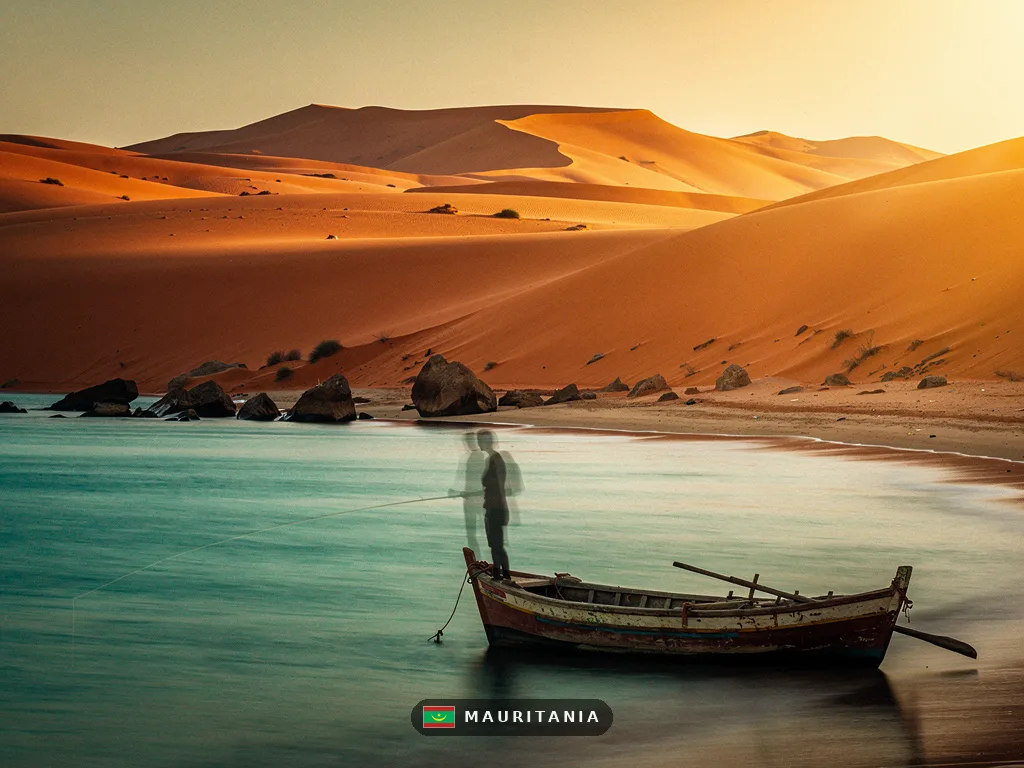
Mauritania offers one of the most pristine and productive marine environments in West Africa, yet fishing in Mauritania remains tightly regulated and largely inaccessible to independent travelers. The country’s 754-kilometer Atlantic coastline sits at the confluence of the cool Canary Current and nutrient-rich upwellings, creating a marine ecosystem that supports enormous schools of fish. For international anglers, the reality is clear: there is no simple “do you need a fishing license in Mauritania” answer that applies to everyone. Most sport fishing must be arranged through registered local operators who secure the necessary authorizations from the Ministry of Fisheries and Maritime Economy. This guide explains exactly how to plan a compliant Mauritania fishing trip, the best fishing spots, charter options, costs, and practical travel information so you can pursue giant trevally, barracuda, and other powerful saltwater species responsibly.
The combination of remote desert coastline, rich biodiversity, and strict oversight makes saltwater fishing Mauritania a true frontier experience. Unlike neighboring Senegal or Morocco, where recreational infrastructure is more developed, Mauritania prioritizes industrial and artisanal fishing as pillars of its “blue economy.” Recreational angling is permitted only in designated zones and almost always under the umbrella of licensed operators. If you dream of casting into waters rarely touched by sport anglers, this can be an unforgettable adventure — provided you follow the rules.
Important note: Regulations can change via ministerial decree. The information below is based on the Fisheries Code (Law No. 2015-017) and current official guidance. Always verify with the Ministry of Fisheries and Maritime Economy or a reputable local operator before your journey.
01Do You Need a Fishing License or Permit in Mauritania?
Understanding the legal framework is the first and most critical step in planning any fishing Mauritanien adventure. Under the Fisheries Code (Law No. 2015-017), all fishing activities — including sport fishing for non-commercial purposes — fall under the authority of the Ministry of Fisheries and Maritime Economy. There is no standardized, publicly available daily or weekly recreational fishing license that foreign visitors can simply purchase at a port or online.
For independent shore fishing with light tackle from public beaches, the situation remains in a legal gray area. Local authorities in Nouadhibou or Nouakchott may tolerate limited hand-line or rod-and-reel fishing by tourists, but technically any extraction of marine resources requires authorization. Attempting to fish without proper clearance risks fines, confiscation of equipment, or worse. The Ministry maintains strict control to prevent overexploitation of one of the world’s most productive fishing grounds.
The practical reality for most international visitors is that you will need a fishing permit in Mauritania arranged through a registered operator. These companies hold the necessary operating authorizations and zoning clearances that allow their clients to fish legally in designated coastal waters. This approach also ensures compliance with protected-species rules, minimum-size limits, and biological rest periods. Many operators include the cost of these permits in their package prices, making the process seamless for guests.
Biological rest periods — temporary closures lasting up to two months — are declared annually to protect spawning stocks. Dates vary by species and region and are published by the Institut Mauritanien de Recherches Océanographiques et des Pêches (IMROP). During these windows, even permitted sport fishing may be restricted. Protected species such as sea turtles, marine mammals, and certain seabirds are strictly off-limits year-round. Using explosives, poisons, or any polluting method is prohibited and carries severe penalties.
Tip: Contact your chosen operator at least three months in advance. They will handle permit applications and advise you on the latest biological rest dates and zoning restrictions. This is the only reliable way to ensure a legal sport fishing Mauritanien experience.
Because the regulatory system is designed primarily for industrial fleets, independent travelers should never assume that “what works in Senegal will work here.” The best practice is to book a guided package that includes all necessary authorizations. This not only keeps you on the right side of the law but also supports local economic development and sustainable resource management.
The Ministry of Fisheries and Maritime Economy publishes updates through the Journal Officiel. IMROP provides scientific background on stock status. Travelers from the EU, US, UK, Japan, and other nations should also check current travel advisories, as some regions of Mauritania carry security considerations unrelated to fishing.
In summary, while a casual tourist fishing license does not exist in the traditional sense, registered operators can provide the legal framework you need. Working with them transforms a potentially complicated bureaucratic process into a safe, well-organized Mauritania fishing trip.
(Word count for this section: 578)
02Best Fishing Spots in Mauritania
The crown jewels of best fishing spots Mauritanien lie along the Atlantic coast between the Moroccan border and the Senegalese frontier. Two areas stand out for visiting sport anglers: the waters surrounding Nouadhibou in the north and the coastal belt near Nouakchott further south. These locations combine dramatic desert scenery with world-class saltwater fishing.
Nouadhibou and Surrounding Waters
Nouadhibou, Mauritania’s second-largest city and principal fishing port, serves as the most practical base for international visitors. Located on the Ras Nouadhibou peninsula, the city is flanked by the Atlantic to the west and the Baie du Levrier to the east. The cold Canary Current collides with nutrient-rich upwellings here, creating a plankton soup that attracts massive bait balls and their predators.
Expect to encounter giant trevally (*Caranx ignobilis*), one of the most powerful inshore gamefish in the world. Specimens exceeding 40 kg (88 lb) are possible, though 15–25 kg fish are more common. Barracuda, especially the great barracuda (*Sphyraena barracuda*), patrol these waters in impressive numbers. Other species include African pompano, various kingfish, snapper, grouper, and occasional dorado during warmer months.
The most productive fishing occurs within 5–15 nautical miles of shore, where underwater plateaus and drop-offs concentrate fish. Local operators launch from the commercial harbor or nearby beaches. Trolling with large plugs and poppers, jigging over structure, and casting to boils are all highly effective. Early morning and late afternoon offer the best weather window, with calmer seas and more aggressive feeding.
Further north toward the Moroccan border, the coastline becomes increasingly remote. These waters see far fewer boats, and the fishing can be spectacular, but logistical challenges and permitting complexities increase. Only experienced operators with proper clearances should attempt these extended trips.
Banc d’Arguin National Park – A Restricted Paradise
The Banc d’Arguin National Park, a UNESCO World Heritage Site, stretches for roughly 200 km along the coast south of Nouadhibou. This vast shallow-water ecosystem of sandbanks, mudflats, and seagrass beds is one of the most important wintering sites for migratory birds in the world. Traditional Imraguen fishermen are allowed to fish here using sail-powered boats and hand lines, but recreational/tourist fishing is generally prohibited within park boundaries.
Some operators may offer trips along the park’s outer edges under special authorization, targeting species that migrate through the deeper channels. However, you must respect the boundaries. Entering the core protected zones without permission can result in heavy fines and vessel impoundment. The park’s ecological importance cannot be overstated; it supports the largest remaining population of monk seals in the Atlantic as well as vast schools of mullet that sustain both birds and fish.
Travelers who combine a visit to the park with fishing outside its boundaries often describe the experience as unforgettable. The contrast between endless golden dunes, turquoise shallows, and the rich marine life creates a unique backdrop for any saltwater fishing Mauritanien journey.
Waters Near Nouakchott
The capital city of Nouakchott offers a different fishing experience. While less developed for tourism than Nouadhibou, the coastal waters here hold good populations of trevally, barracuda, and various snapper species. The continental shelf drops more sharply in this region, allowing access to deeper waters within a shorter run from port. Deep-sea fishing Mauritania trips departing from Nouakchott can reach productive grounds in 30–60 minutes rather than the longer transits sometimes required from Nouadhibou.
Many anglers combine a few days in Nouakchott with a longer stay in the north. The city also serves as a logistical hub with better international flight connections via Turkish Airlines, Air Mauritania, and connections through Casablanca or Dakar.
Seasonal Patterns and Target Species
The fishing calendar in Mauritania is strongly influenced by seasonal upwelling intensity and water temperature. The most consistent action for giant trevally and other inshore species runs from October through May, when cooler water temperatures bring baitfish closer to shore. June to September can see warmer surface temperatures and occasional rougher seas, although experienced crews still operate during this period.
Key target species include:
Because the ecosystem remains relatively lightly pressured by recreational anglers, fish tend to be larger and more aggressive than in many better-known African destinations. This is genuine frontier fishing — the kind that creates lifelong memories.
The combination of desert landscape and rich ocean creates a dramatic setting. Imagine casting from a skiff with golden dunes behind you and a 30-kilogram trevally screaming line off your reel. Or watching a massive flock of flamingos take flight while waiting for a strike 10 km offshore. These are the moments that make Nouadhibou fishing and Mauritanian coastal angling so special.
Operators emphasize sustainable practices. Many encourage catch-and-release for giant trevally and other iconic species, keeping only what can be reasonably consumed. This approach helps preserve the resource for future generations and aligns with the government’s desire to develop a responsible “blue economy.”
(Word count for this section: 942)
03Tours & Guided Experiences
Because independent fishing is heavily restricted, almost all successful fishing tours Mauritanien are organized through a handful of specialized local operators who maintain the required relationships with maritime authorities. These companies provide vessels, experienced captains, tackle, permits, and often accommodation and transfers.
Most tours depart from Nouadhibou. Typical offerings include one-day inshore trips targeting giant trevally and barracuda, multi-day expeditions that combine fishing with desert camping, and occasional longer-range deep-sea excursions. Prices generally start at around €800–€1,200 per boat per day (approximately $870–$1,300 USD) for a shared trip with up to four anglers. Private charters for two or three days often range from €2,500 to €4,500 depending on the vessel size, distance traveled, and included services.
A standard day trip usually includes:
Longer expeditions may add desert 4×4 transfers, overnight camping in traditional Bedouin-style tents, meals prepared with freshly caught fish, and visits to remote fishing grounds inaccessible on day trips. These multi-day experiences allow anglers to fish different habitats — from shallow rocky points to offshore banks — and truly immerse themselves in the Saharan coastal environment.
Guides are typically multilingual (French, Arabic, and often English or Spanish). Communication can still be challenging; using translation apps and learning basic French fishing terminology helps. Most operators cater to European clients, particularly from France, Spain, and Germany, as well as a growing number of serious anglers from the Middle East and Asia.
Safety is taken seriously. Vessels carry required safety equipment, captains monitor marine forecasts closely, and operators maintain radio contact with shore authorities. However, Mauritania’s waters can produce strong currents and sudden wind shifts. Respect the captain’s decisions regarding weather and distance from port.
Many operators now incorporate sustainable practices. They promote selective tackle that facilitates quick release, avoid fishing during known spawning aggregations when possible, and support local Imraguen communities through employment and supply contracts. Some trips include an educational component about the Banc d’Arguin ecosystem and the importance of responsible fishing.
When choosing an operator, look for companies that are formally registered with the Ministry of Fisheries and can clearly explain which zones they are permitted to fish. Reputable operators will also provide references from previous international clients. Because the industry remains small and specialized, personal recommendations within the international sport-fishing community carry significant weight.
For travelers arriving from Europe, direct flights to Nouakchott or connections via Casablanca to Nouadhibou make logistics manageable. Those coming from North America or Asia should plan at least two travel days each way. Many operators offer full packages that include airport transfers, hotel accommodation in Nouadhibou (basic but clean and secure), and all meals.
A typical six-day package — including two full days of fishing, desert excursions, and all logistics — might cost between €2,800 and €4,200 per person based on double occupancy. This represents a significant investment, but one that delivers access to waters few recreational anglers ever experience. Compared with similar remote destinations such as certain atolls in the Indian Ocean or Pacific islands, Mauritania offers competitive value when the quality of fishing and exclusivity are considered.
Language barriers exist but are manageable with good operators. Learning a few basic French phrases — “Je voudrais pêcher le trevally géant” (I would like to fish for giant trevally) — goes a long way. Most captains understand the universal language of bent rods and screaming drags.
The guided experience also provides invaluable local knowledge. Captains know exactly where and when certain species feed, which lure colors perform best under specific water conditions, and how to navigate the complex currents around underwater plateaus. This expertise dramatically increases your chances of success and ensures you fish legally and safely.
(Word count for this section: 872)
04Charter Fishing in Mauritania
Charter fishing Mauritania is the only truly practical way for most international visitors to experience the country’s marine riches. The vessels available range from traditional wooden pirogues adapted for sport to more modern fiberglass center-console boats equipped with outriggers and fighting chairs for bigger game.
Most charters operate from the port of Nouadhibou. The fleet is small but growing as the government encourages development of sustainable tourism. Expect boats between 6 and 12 meters in length. Larger vessels can comfortably take four to six anglers, while smaller, more agile boats are ideal for two or three people targeting inshore structure.
Daily charter rates typically range from 650–950 EUR ($700–$1,030 USD) for a full day, including fuel, crew, tackle, and permits. Multi-day charters naturally offer better per-day value. Some operators offer all-inclusive packages that also cover accommodation, meals, airport transfers, and ground transportation. These can represent better value for anglers traveling from far away.
Captains are almost always local fishermen with decades of experience on these waters. Many have transitioned from commercial or artisanal fishing to the growing sport-fishing sector. Their knowledge of local conditions, fish behavior, and safe navigation is exceptional. However, the standard of English varies; many captains speak excellent French, so having at least one person in your group comfortable with French is helpful.
Tackle provided is usually heavy spinning or conventional gear suitable for giant trevally and large barracuda. Serious anglers often prefer to bring their own high-quality reels spooled with 30–50 kg (65–110 lb) braid and a selection of poppers, stickbaits, and metal jigs. Lead-core lines and wire leaders are essential when targeting toothy species.
Deep-sea charters targeting tuna, marlin, or wahoo are still in their infancy in Mauritania. The infrastructure for true blue-water sport fishing remains limited compared with Senegal or the Cape Verde islands. Most current charters focus on the highly productive inshore and mid-shelf zones where giant trevally, barracuda, and various reef species provide consistent action.
When booking, confirm exactly what is included. Reputable operators will provide a clear itinerary, explain the permit situation, detail safety protocols, and outline their sustainability policies. Many now use circle hooks to facilitate better catch-and-release outcomes and train crews in proper fish handling to minimize mortality.
Security and comfort levels vary. Mauritania has made significant strides in improving port facilities, but conditions remain basic compared with Mediterranean or Caribbean charter destinations. Cabins may be simple, toilet facilities basic, and air-conditioning not always available. Most clients find the authenticity and quality of the fishing more than compensate for the lack of luxury.
For anglers combining fishing with cultural interest, some charters can arrange visits to Imraguen fishing villages (outside the strict national park core) where you can observe traditional methods that have remained largely unchanged for centuries. These experiences highlight the contrast between modern sport fishing and the ancient sustainable practices that still exist along this coast.
The charter experience also offers an excellent platform for photography and filmmaking. The dramatic backdrop of red dunes meeting turquoise water creates stunning visuals, especially at sunrise and sunset when the light is magical.
Booking well in advance is essential. The number of permitted vessels is limited, and the best captains are often reserved months ahead, particularly during the peak season from November to April. Working with established operators who have strong relationships with maritime authorities ensures your charter will not be disrupted by permitting issues.
(Word count for this section: 612)
05Practical Travel Info for Your Mauritania Fishing Trip
Reaching Mauritania requires careful planning. Most international visitors fly into Nouakchott–Oumtounsy International Airport (NKC). From there, you can connect domestically to Nouadhibou (NDB) via Air Mauritania or take a long but scenic overland journey. Several European carriers and Turkish Airlines offer connections through Casablanca, Dakar, or Istanbul.
Visa requirements vary by nationality. Citizens of the EU, UK, US, Canada, Japan, and many other countries can obtain a visa on arrival or must apply in advance through a Mauritanian embassy or approved e-visa system. Check the latest requirements with your local Mauritanian diplomatic mission at least two months before travel. Yellow-fever vaccination is strongly recommended and may be required for entry if arriving from certain countries.
Health considerations are important. Consult a travel medicine specialist about malaria prophylaxis, hepatitis A and B, typhoid, and routine vaccinations. Tap water is not safe to drink; stick to bottled water. Medical facilities in Nouadhibou are limited; serious conditions usually require evacuation to Europe or Dakar. Travel insurance that covers medical evacuation and fishing-related activities is essential.
Security has improved considerably in the coastal regions used for fishing, but you should still register with your embassy’s traveler program and monitor current advisories. Stick to organized tours and avoid traveling alone to remote areas. The operators you book with are your best source of up-to-date local safety information.
Accommodation in Nouadhibou is functional rather than luxurious. Several small hotels and guesthouses catering to European fishing groups offer clean rooms, reliable electricity, and basic Wi-Fi. Expect to pay 35–70 EUR ($38–$76 USD) per night. Some fishing packages include accommodation in traditional desert camps that provide an unforgettable cultural element.
Currency is the Mauritanian ouguiya (MRU). As of early 2026, 1 EUR ≈ 42 MRU and 1 USD ≈ 39 MRU. ATMs exist in Nouadhibou and Nouakchott but frequently run out of cash. Bring sufficient euros or US dollars in clean bills. Credit cards are rarely accepted outside major hotels.
Language is primarily Arabic (Hassaniya dialect) and French. English is not widely spoken outside tourist-oriented businesses. Download offline translation apps and consider hiring a local guide or fixer for non-fishing days. Learning basic French fishing terms will enhance your communication with captains.
Internet access is improving but remains slow and unreliable outside major towns. An international eSIM or local SIM card purchased on arrival can help you stay connected for weather updates and communication with operators.
Transportation within the country for fishing clients is almost always arranged by the operator. Independent car rental is possible but not recommended for remote coastal areas due to difficult navigation, security considerations, and lack of support infrastructure.
Local cuisine revolves around fresh fish, rice, and vegetables. Many operators serve meals featuring the day’s catch prepared in traditional Mauritanian style with spices and couscous. Tea culture is central to social life; be prepared for multiple rounds of strong, sweet mint tea after each fishing session.
Cultural sensitivity is important. Mauritania is a conservative Muslim country. Dress modestly, especially outside fishing boats. Women should cover shoulders and knees. Respect local customs regarding photography of people and religious sites.
For travelers coming from different hemispheres, the best time to visit depends on your home climate. Northern-hemisphere anglers find the October–May window ideal because it coincides with cooler European winters. Southern-hemisphere visitors may prefer the same period to escape their summer heat. The fishing remains viable year-round with proper planning around biological rest periods.
Packing list essentials include:
Mauritania rewards those willing to accept a more adventurous travel style. The combination of untouched marine wilderness, dramatic desert landscape, and the thrill of targeting powerful fish in lightly fished waters creates an experience very different from crowded charter destinations elsewhere in the world.
(Word count for this section: 728)
06Equipment and Sustainable Practices
Successful deep sea fishing Mauritania and inshore sport fishing require robust tackle capable of handling powerful runs in often challenging conditions. Most operators provide basic heavy spinning outfits, but bringing your own premium reels is advisable.
Recommended setup for giant trevally:
For lighter inshore work targeting pompano and smaller species, 10–20 kg class spinning outfits provide excellent sport.
Because the sun is intense and reflection off the water is brutal, quality polarized sunglasses with high UV protection are non-negotiable. A buff or neck gaiter helps protect against wind and sunburn.
Sustainable practices are increasingly important in Mauritanian waters. The government and IMROP monitor stocks closely. Many operators now follow voluntary best practices even when not strictly required by law. These include:
Anglers who demonstrate respect for these principles often receive better local cooperation and access to more exclusive fishing zones. Supporting operators who employ local Imraguen crew members and contribute to community development also helps ensure the long-term viability of recreational fishing in the region.
(Word count for this section: 485)
🎣 Fishing tours in Mauritania — Book guided fishing tours with local experts.
🚤 Charter fishing in Mauritania — Find and book charter boats with experienced captains.
🛒 Fishing equipment for Mauritania — Find the right gear for your trip.
07FAQ – Fishing in Mauritania
Do you need a fishing license in Mauritania for recreational angling?
There is no simple daily tourist fishing license. All sport fishing should be conducted through registered local operators who obtain the necessary authorizations from the Ministry of Fisheries and Maritime Economy. Attempting to fish independently without verification can result in legal issues. Guided tours effectively provide the legal framework you need.
What is the best time of year for a Mauritania fishing trip?
The most consistent fishing for giant trevally and barracuda occurs from October through May when cooler waters bring baitfish closer to shore. Biological rest periods declared by the government may restrict certain activities during specific months, so check with your operator well in advance.
Is it possible to fish inside Banc d’Arguin National Park?
Recreational tourist fishing is generally prohibited within the core areas of the park. Traditional Imraguen fishermen have limited rights using non-motorized methods. Some operators can arrange trips along the outer edges under special authorization, but you must respect protected boundaries.
What species can I realistically expect to catch?
Giant trevally is the star species, with fish over 30 kg possible. Barracuda, African pompano, various groupers, snappers, and seasonal dorado are also common. The nutrient-rich waters support large fish that fight powerfully in relatively lightly pressured environments.
How much does a typical fishing charter cost in Mauritania?
Daily charter rates generally range from €650 to €1,200 ($700–$1,300 USD) depending on boat size, number of anglers, and distance traveled. Multi-day all-inclusive packages including accommodation, transfers, and permits typically cost €2,800–€4,500 per person for six days.
Is Mauritania safe for international fishing visitors?
Coastal areas used for fishing tourism have seen significant security improvements. However, travel requires careful planning, appropriate insurance, and adherence to your operator’s guidance. Register with your embassy and monitor current travel advisories. Organized tours significantly reduce risk.
What language is spoken on fishing charters?
Most captains speak French and Arabic (Hassaniya). English proficiency varies. Operators catering to international clients often provide English-speaking coordinators. Translation apps and basic French phrases help facilitate communication on the water.
Do I need to bring my own fishing tackle?
Operators provide basic heavy outfits suitable for the local conditions. However, most serious anglers bring their own high-quality reels, favorite lures, and terminal tackle. Strong braid, heavy leaders, and large poppers and jigs are particularly effective.
(Word count for FAQ section: 512)
08Conclusion
A Mauritania fishing trip is not a casual vacation — it is a genuine expedition into one of the last great fishing frontiers of West Africa. The combination of nutrient-rich Atlantic waters, dramatic Saharan coastline, and the pursuit of powerful fish like giant trevally creates an experience that stands apart from more commercialized destinations. By working with established local operators, respecting strict regulations, and embracing sustainable practices, you can enjoy world-class saltwater fishing while contributing to the responsible development of Mauritania’s blue economy.
The memories of fighting a massive trevally against a backdrop of golden dunes, sharing mint tea with local captains, and witnessing an ecosystem still pulsing with life will stay with you long after you return home. Plan carefully, book with reputable operators who hold proper authorizations, and prepare for an adventure that few anglers ever experience.
Whether you are an experienced saltwater angler seeking new challenges or a traveler looking to combine extraordinary fishing with unique cultural immersion, Mauritania offers something truly special. The fish are waiting — the only question is whether you are ready for one of Africa’s most exclusive fishing experiences.
09Sources & Further Links
Disclaimer: This guide is for informational purposes only and reflects the best available information as of 2026. Fishing regulations, permit requirements, biological rest periods, and safety conditions in Mauritania can change at any time. Always consult the Ministry of Fisheries and Maritime Economy and your chosen operator for the most current rules before planning or undertaking any fishing activities. The authors and FishingWorldGuide.com assume no liability for any errors, omissions, or incidents that may occur during your travels. Verify all visa, health, and security requirements with official government sources.
Don't miss any fishing tips!
Get the best fishing destination recommendations weekly in your inbox.
No spam. Unsubscribe anytime.
Data incorrect?
Help us keep this article up to date — report outdated or incorrect information
More articles