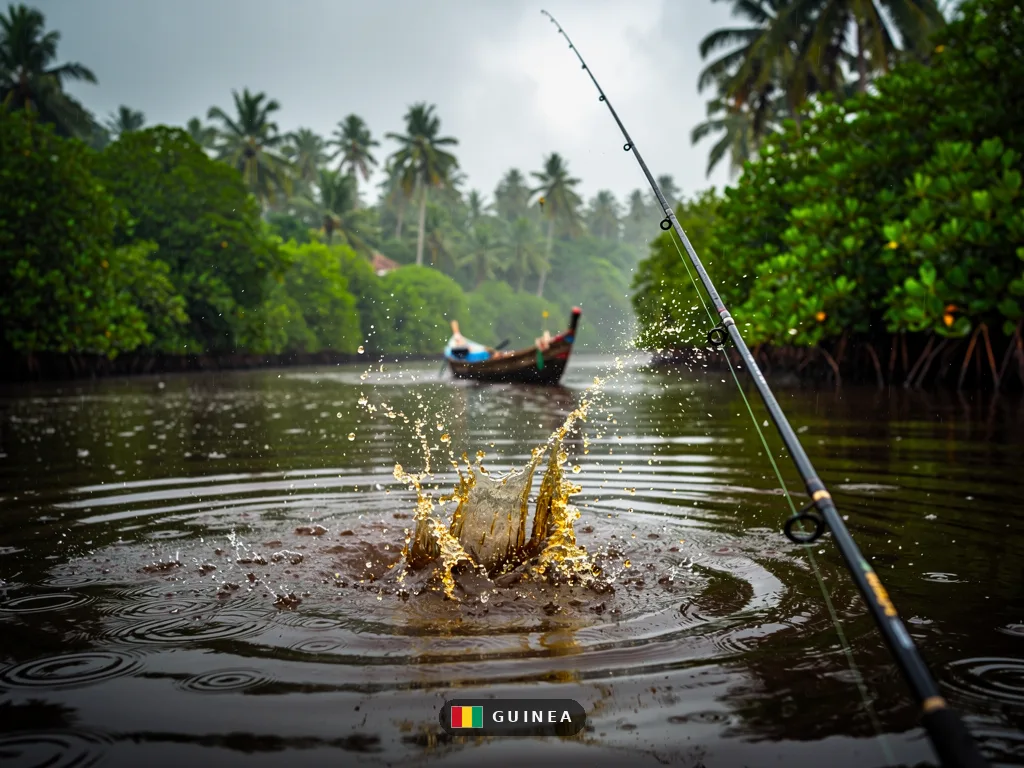
Fishing in Guinea offers a raw and rewarding West African adventure for those willing to venture off the beaten path. With its vast Atlantic coastline, nutrient-rich waters fed by major rivers like the Niger and Konkouré, and a recently modernized legal framework for maritime activities, Guinea is emerging as a destination for serious anglers seeking trophy fish in relatively untouched waters. Whether you are chasing powerful tarpon that leap dramatically near river mouths, battling large barracuda in the reefs, or targeting cubera snapper and cobia in deeper offshore grounds, the country delivers exciting sport fishing experiences.
This comprehensive guide covers everything you need to know for a successful trip in 2026. You will learn exactly when and where to fish, whether you need a fishing license in Guinea, how to book reliable charter fishing in Guinea, current costs in both local Guinean francs (GNF), euros, and US dollars, and practical travel advice tailored for visitors from Europe, North America, Asia, and beyond. All information is drawn from official regulations published by the Ministry of Fisheries and Aquaculture.
Do you need a fishing license in Guinea? For most visitors participating in organized recreational fishing, the answer is effectively no — the permit is handled by your operator. Independent fishing, however, requires direct contact with authorities. Guinea’s new Code of Maritime Fishing, adopted in 2025, formally recognizes *pêche récréative* (recreational fishing) and places clear responsibilities on licensed operators to ensure compliance.
Important note: Regulations can change. Always verify the latest rules with your chosen operator or the official portal before travel.
01Fishing Licenses and Permits in Guinea
Understanding the fishing permit Guinea requirements is the first step in planning a compliant and stress-free trip. The country has significantly updated its maritime fishing legislation with the 2025 Code of Maritime Fishing. This legal update distinguishes clearly between commercial, artisanal, and recreational fishing, creating a more structured environment for international sport anglers.
Recreational fishing is now officially defined as any non-commercial activity undertaken for tourism, leisure, or sport. If you book your trip through a recognized charter operator registered with the *Ministère de la Pêche, de l’Aquaculture et de l’Économie Maritime* (MPAEM), the fishing license is almost always included in the package price. These operators maintain the necessary permits and ensure that all clients fish within legal boundaries. This arrangement removes much of the administrative burden from individual travelers and is the recommended route for the vast majority of visitors.
For those considering independent fishing — bringing your own small boat, renting a local pirogue without a formal operator, or fishing from shore for extended periods — the situation is less straightforward. The law requires that any fishing activity by foreigners be covered by an appropriate permit. Independent anglers should contact the MPAEM well in advance through the official portal . At the time of writing, specific tourist recreational fishing permits for independent activity are not widely advertised online, which strongly suggests that organizing through an established tour operator is the safest and most practical choice.
Costs for permits themselves, when not included in a charter, are not publicly listed in a standard tariff. However, operators typically bundle the administrative costs into daily charter rates. Expect any additional permit fees to fall in the range of 150,000–400,000 GNF (approximately €15–€40 or $16–$43 USD) per person per day when arranged separately, though most packages absorb this expense.
When fishing, you must carry your passport or a certified copy. Maritime authorities or police may conduct checks, particularly near Conakry and in the Loos Islands area. Failure to demonstrate proper authorization can lead to fines or confiscation of equipment. Guinea continues to crack down on Illegal, Unreported, and Unregulated (IUU) fishing, meaning enforcement is taken seriously.
Sustainable practices are emphasized throughout the regulations. You are expected to respect minimum size limits (though exact sizes for every species are still being harmonized under the new code), practice catch-and-release for certain trophy fish, and never use destructive methods such as explosives, chemicals, or undersized nets. Protected species must be released immediately.
Travelers from the European Union, United States, United Kingdom, Japan, and most other countries will find that the operator-managed system makes compliance relatively easy. The key is to avoid informal arrangements with local fishermen that are not registered as tourism operators. Such arrangements may appear cheaper but carry legal risks. (Word count for this section: 582)
02Best Fishing Spots in Guinea
The best fishing spots in Guinea are concentrated along the 320 km Atlantic coastline and the extensive network of mangrove-lined estuaries and offshore reefs. The waters benefit from the influence of the Canary Current and major river outflows that deliver nutrients, creating rich feeding grounds for a wide variety of game fish.
Conakry and the Loos Islands (Îles de Loos) represent the most accessible and productive zone for international visitors. Located just a short boat ride from the capital, these islands offer a mix of rocky shores, sandy beaches, and coral-fringed drop-offs. Here you can target tarpon fishing in Guinea during the wetter months when these silver kings move into the estuarine systems. Tarpon weighing 40–80 kg (88–176 lb) are possible, with fish occasionally exceeding 100 kg (220 lb). The acrobatic fights in relatively shallow water near mangrove channels create unforgettable moments.
Further offshore from Conakry, the continental shelf drops dramatically, providing excellent deep sea fishing Guinea opportunities. Trolling and jigging in 30–80 meters (100–260 ft) of water regularly produces cubera snapper that can exceed 40 kg (88 lb), powerful cobia, and large barracuda. The underwater topography includes submerged pinnacles and wrecks that act as fish magnets. Many charters report consistent action on popping and jigging for trevally species as well, including giant trevally on certain tide stages.
The Konkouré River estuary south of Conakry is another premier location. This area features extensive mangroves and brackish water zones that serve as nurseries and hunting grounds. During the transition between dry and wet seasons, large jack crevalle, cubera snapper, and African threadfin gather here. The scenery is dramatic — dense green mangroves meet tannin-stained waters that eventually merge with the deep blue Atlantic. Fishing here often combines light tackle casting with heavier setups for the bigger predators.
North toward the border with Guinea-Bissau, the Tristao Islands and surrounding coastal lagoons offer more remote experiences. These areas see fewer visitors and can produce exceptional catches of barracuda and various snapper species. Access is more complicated, usually requiring multi-day expeditions organized by specialized operators. The water clarity varies with rainfall, but the biomass in these less-pressured waters can be remarkable.
South of Conakry toward the Sierra Leone border, the Forecariah region features rocky points and small islands that create natural current breaks. These spots are productive for both boat-based and limited shore fishing. Cobia often patrol these structures, while king mackerel and various tuna species pass through during seasonal migrations.
Each of these locations has distinct seasonal patterns. The dry season (November to April) generally offers calmer seas and better visibility for sight fishing and popping. Water temperatures range from 24–28 °C (75–82 °F). The wet season (May to October) brings higher rainfall, increased river outflow, and often better tarpon fishing as the fish follow baitfish into the estuaries. However, sea conditions can deteriorate rapidly during the height of the rainy season, so flexible scheduling with your operator is essential.
When fishing these Guinea spots, respect local communities. Many coastal villages rely on artisanal fishing. Avoid fishing directly in front of active village beaches unless accompanied by a guide who has local permission. Many charters include a cultural element, stopping at villages to purchase fresh produce or interact respectfully with locals.
The combination of rich biodiversity, varied underwater structure, and the raw beauty of Guinea’s coastline makes these waters special. Standing on the deck of a charter boat as the African sun rises over the mangroves while waiting for a tarpon strike is an experience that stays with anglers for a lifetime. The relative lack of heavy commercial sport fishing pressure compared to more famous African destinations like Senegal or Ghana means fish stocks remain healthy in many areas — provided everyone follows the sustainable practices outlined in the 2025 maritime code.
Anglers who have fished neighboring countries often remark that Guinea’s mix of estuary and offshore fishing offers a unique variety in a single trip. You can realistically catch fish in mangrove creeks in the morning and battle pelagics 20 nautical miles offshore in the afternoon. This diversity is one of the strongest attractions for recreational fishing Guinea.
The Loos Islands in particular deserve deeper exploration. These four main islands — Tamara, Kassa, Room, and Blanche — sit between 5 and 10 km from Conakry harbor. The channels between them create strong tidal currents that concentrate baitfish. During the right moon phases, fishing the rips with large poppers or live bait can produce explosive strikes from giant trevally and big barracuda. The islands also feature small hidden coves perfect for light tackle fishing for snapper and grouper when the offshore conditions are too rough.
Further out, the “100-meter line” approximately 25–35 km from Conakry is a favored deep-sea fishing ground. Here the bottom composition changes and upwellings bring cold, nutrient-rich water to the surface. Trolling with large plugs or rigging live bait for sailfish and other billfish is possible during certain months, although marlin catches remain rare compared to further north in Senegalese waters.
Experienced captains know secret spots around submerged rock formations whose exact coordinates are closely guarded. These “honey holes” often hold resident populations of large cubera snapper that rarely see angling pressure. Successful anglers usually combine local knowledge with modern electronics to find and fish these areas efficiently.
For those interested in exploring beyond the Conakry region, longer-range trips to the Bijagos-influenced waters near the northern border can be arranged. These expeditions typically last 4–7 days and involve mother-ship operations or camping on remote islands. The fishing quality is often described as spectacular, with larger average fish sizes due to lower angling pressure. However, such trips require significant planning, proper permits, and acceptance of basic accommodation standards.
No matter which fishing spots in Guinea you choose, the experience is defined by the power of the fish and the wild beauty of the environment. The African coastline here feels untouched compared to many heavily developed fishing destinations. Pelicans, terns, and occasional dolphins often accompany the boats, while the distant green hills of the Fouta Djallon highlands provide a dramatic backdrop on clear days.
Always remember that conditions can change quickly. Guinea sits in the transition zone between the Sahel and the equatorial rain belt. Sudden squalls are possible even in the dry season. Professional operators monitor weather closely and will adjust plans to keep you safe while maximizing fishing time. (Word count for this section: 928)
03Tours and Guided Experiences
Fishing tours in Guinea are the most practical and legally secure way to experience the country’s sport fishing potential. Almost all quality operations are based in or near Conakry, with boats ranging from 6–12 meters (20–40 ft) center-console vessels equipped with modern outboards to larger cabin boats suitable for multi-day expeditions.
Most guided trips follow a similar structure. You are collected from your hotel in Conakry, transferred to the harbor, and head out for a full day of fishing. Packages typically include the boat, captain, fuel, fishing license (handled by the operator), basic tackle, and sometimes bottled water and snacks. Lunch is often fresh fish cooked on board or at a beach stop. Larger groups of up to four anglers share the daily rate, making the experience more affordable per person.
Target species and techniques are tailored to the season and client preferences. For tarpon fishing in Guinea, guides favor the estuarine zones during the rising tide, using live bait or large artificial lures. When the fish are aggressive, sight casting to rolling tarpon in the channels creates heart-stopping moments. For deep sea fishing Guinea, the focus shifts to trolling, vertical jigging with heavy metal lures, and popping for surface action. Many captains are skilled at reading the water and locating productive rips and color changes.
Several established operators work in the region, although the industry remains relatively small-scale compared to neighboring Senegal or Ghana. Reputable companies maintain proper safety equipment, communication devices, and insurance. They also hold the necessary commercial registrations that cover the recreational fishing permits of their clients. Prices for a standard full-day charter suitable for 2–4 anglers typically range from $350 to $550 USD (320,000–500,000 GNF or €320–€510). Premium offshore boats with professional English-speaking captains and high-quality tackle can cost $650–$800 USD per day (590,000–730,000 GNF or €600–€740).
Multi-day trips that combine fishing with basic island camping or stays in small eco-lodges start from $2,200 USD for a three-day package. These longer experiences allow access to more remote best fishing spots in Guinea and often produce the largest fish of the trip.
When choosing a tour, look for operators who emphasize sustainable practices. The best ones encourage catch-and-release for tarpon and large snapper, use circle hooks to minimize injury, and avoid fishing in spawning aggregation areas. They also work with local fishing communities rather than competing with them.
Language can be a consideration. While many captains speak French and some English, communication is often supplemented by practical demonstration. Using a professional translator app such as Google Translate with offline French and local language packs can help. The most successful trips occur when clients remain flexible and respectful of local customs and pacing.
Safety is taken seriously by good operators. Boats carry life jackets, first-aid kits, and VHF radios. However, Guinea’s waters can be challenging. Swells from Atlantic storms sometimes make the harbor bar at Conakry difficult to navigate. Reputable captains will cancel or modify trips in unsafe conditions rather than risk clients.
Many tours combine fishing with light sightseeing. A typical day might include fishing the Loos Islands in the morning, enjoying a fresh seafood lunch on a quiet beach, then targeting different species in the afternoon. Some operators offer specialized trips focusing exclusively on fly fishing for smaller species in the mangroves or heavy tackle expeditions for giant African threadfin.
For visitors coming from Europe or North America, the relatively low cost compared to famous destinations in the Caribbean or Indian Ocean makes Guinea attractive. A full day of high-quality fishing with the chance at true trophy fish can cost less than a middling day in the Florida Keys or the Bahamas.
The guided experience also provides cultural context. Knowledgeable captains often explain the significance of certain fish to local communities, point out historical sites along the coast, and share stories of traditional fishing methods using hand-carved pirogues. This broader experience enriches the journey beyond simply catching fish.
Booking in advance is strongly recommended, especially during the peak dry season from December to March. Many operators have only a handful of boats and cater to both international visitors and the small local expatriate community. Last-minute bookings are sometimes possible but may limit your choice of vessels and captains.
Overall, participating in organized fishing tours in Guinea is not merely a convenience — it is the best way to ensure your trip is legal, safe, productive, and memorable. The operators understand the complex tidal systems, seasonal fish movements, and regulatory environment in ways that independent travelers cannot easily replicate. (Word count for this section: 812)
🎣 Fishing tours in Guinea — Book guided fishing tours with local experts.
🚤 Charter fishing in Guinea — Find and book charter boats with experienced captains.
04Equipment and What to Bring
Successful deep sea fishing in Guinea and inshore efforts require appropriate tackle that can handle powerful fish in warm, sometimes challenging conditions. Most charters provide basic equipment, but serious anglers usually prefer to bring at least some of their own gear.
For tarpon and large jacks, bring heavy spinning or conventional reels spooled with 30–50 kg (65–110 lb) braid. Pair these with rods rated 20–40 kg (44–88 lb). Large poppers (12–18 cm), stickbaits, and pencil lures in white, chartreuse, and orange are effective. Live bait (mullet or threadfin) is often used when fish are finicky.
For reef and bottom fishing, medium-heavy jigging outfits with 200–300 g jigs work well for cubera snapper and cobia. Bring a selection of assist hooks, fluorocarbon leaders (80–150 lb test), and strong pliers for hook removal.
Fly anglers should pack 10–12 weight rods with floating and intermediate lines for tarpon in the estuaries. Large crab and baitfish patterns in sizes 2/0 to 6/0 are essential.
Other essential items include polarized sunglasses with high UV protection, reef-safe sunscreen (SPF 50+), a wide-brimmed hat, and quick-dry clothing in neutral colors. A lightweight rain jacket is useful even in the dry season. Bring insect repellent for evenings near the mangroves.
If you plan to keep some fish for dinner, check with your operator about local size limits and preferred species. Many charters encourage taking only what you can eat the same day.
05Practical Travel Information for Guinea
Planning the practical side of your trip is essential. Guinea requires a visa for nearly all international visitors, including citizens of the EU, US, UK, and Japan. The easiest method is to apply for an e-Visa online through the official Guinean government portal several weeks before departure. Processing usually takes 5–10 working days. Single-entry tourist visas are typically valid for 30–90 days and cost approximately €80–€120 ($85–$130 USD).
Health requirements are strict. You must present proof of a valid Yellow Fever vaccination upon arrival. Malaria is prevalent, so consult a travel doctor about appropriate prophylaxis. Hepatitis A and Typhoid vaccinations are also recommended. Drink only bottled or properly treated water. Comprehensive travel insurance that includes medical evacuation is strongly advised, as local medical facilities are limited.
Conakry International Airport (CKY) receives flights from major European hubs (Paris, Brussels, Istanbul) and several West African capitals. Flight times from Europe are approximately 6–7 hours. Once in Conakry, most fishing operators offer airport transfers as part of their packages. Taxis and ride-hailing services are available but require caution, especially at night.
The official currency is the Guinean franc (GNF). At the time of writing, 1 USD ≈ 8,650 GNF, 1 EUR ≈ 9,350 GNF. US dollars and euros are widely accepted in Conakry for larger purchases, but carry some local currency for smaller expenses. ATMs are available in the capital but can be unreliable. Credit cards are accepted only in a few high-end hotels and restaurants.
French is the official language. While some people in the fishing industry speak basic English, you will have a much smoother experience if you learn a few basic French fishing-related phrases or travel with a translation app. Local ethnic languages such as Susu, Pular, and Maninka are also widely spoken in coastal areas.
The best time to visit depends on your priorities. The dry season (November–April) offers more stable weather, calmer seas, and easier navigation — ideal for first-time visitors and offshore fishing. Average daytime temperatures are 28–32 °C (82–90 °F). The wet season (May–October) can produce exceptional tarpon fishing but also heavy rains and occasional rough seas. Serious anglers often target the shoulder months of April–May and October–November for a balance of good fishing and reasonable weather.
Electricity is 220V with European-style plugs. Mobile phone coverage is decent near Conakry but patchy in remote coastal areas. Consider purchasing a local SIM card upon arrival for approximately 30,000 GNF (€3 / $3.20 USD) with data packages.
📱 Stay connected in Guinea — Get an eSIM for affordable mobile data while traveling.
Security in Conakry has improved but travelers should exercise normal caution. Avoid displaying expensive equipment openly. Use registered operators who know which areas are safe for visitors. Political demonstrations occasionally occur in the capital; your operator will advise you of any current situations.
When comparing costs to other destinations, a full day of charter fishing in Guinea at $400–$600 USD is roughly comparable to mid-range options in Costa Rica or Mexico but offers significantly less crowded waters and the chance at unique West African species.
🚗 Rent a car in Guinea — Compare prices from 500+ rental companies worldwide.
06FAQ – Common Questions About Fishing in Guinea
Do you need a fishing license in Guinea for recreational fishing?
If you fish with a recognized charter operator, the license is typically included in the price and handled by the company. The 2025 Code of Maritime Fishing allows this arrangement. Independent fishing requires contacting the Ministry of Fisheries directly via peches.gov.gn to obtain the proper permits. For almost all international visitors, using an operator is the recommended and simplest route.
What are the best months for tarpon fishing in Guinea?
The period from May to October, corresponding with higher river outflow, generally offers the best opportunities for large tarpon in the estuarine systems. However, fish can be caught year-round. The dry season from December to March provides calmer conditions for sight fishing but may see slightly fewer fish in the shallow zones.
How much does a fishing charter cost in Guinea?
A standard full-day charter for up to four people costs between $350 and $800 USD depending on the boat quality, distance traveled, and services included. Most packages fall in the $400–$550 range. This is usually all-inclusive of the fishing permit, fuel, basic tackle, and transfers from Conakry hotels.
Is it safe to go fishing in Guinea?
When using professional, registered operators, fishing is generally safe. Boats carry safety equipment and captains monitor weather conditions carefully. Standard travel precautions apply — use reputable companies, follow local advice, and maintain situational awareness in the capital. Comprehensive travel insurance is essential.
What species can I realistically catch in Guinea?
Common catches include tarpon (up to 100+ kg), barracuda, cubera snapper, cobia, jack crevalle, various trevally, African threadfin, and occasionally king mackerel or small tuna. The combination of estuarine and deep-sea environments allows for a very diverse range of fishing styles in a single trip.
Can I bring my own fishing rod to Guinea?
Yes. There are no specific restrictions on importing personal fishing tackle for recreational use. Pack rods carefully in a hard case and declare them if asked. Many experienced anglers bring favorite lures and reels while using the boat’s heavier offshore gear when needed.
What vaccinations and documents do I need?
Yellow Fever vaccination is mandatory and must be documented in an International Health Certificate. A valid visa is required. Carry your passport, a copy of your visa, and proof of vaccination at all times. Additional recommended vaccinations include Hepatitis A, Typhoid, and Tetanus. Consult a travel clinic 6–8 weeks before departure.
Is fly fishing possible in Guinea?
Yes, particularly in the mangrove channels and estuaries for tarpon, jacks, and smaller species. The dry season offers better conditions for casting due to calmer winds. Specialized fly-fishing charters can be arranged, although they are less common than conventional tackle operations. Bring heavy-duty saltwater fly gear (10–12 weight).
07Conclusion
Fishing in Guinea represents a genuine frontier experience in West Africa. The combination of powerful game fish, diverse coastal habitats, and a legal system that now clearly supports recreational angling through licensed operators makes it an increasingly attractive destination. By working with professional charters, securing the necessary visa and health documents, and respecting local regulations and communities, you can enjoy world-class tarpon fishing, exciting deep sea fishing, and the wild beauty of the Guinean coast.
Whether you are a first-time visitor to Africa or a seasoned traveler looking for new challenges, Guinea offers memorable days on the water that will stay with you long after you return home. The fish are strong, the scenery is dramatic, and the sense of exploration is real.
Start planning your trip today by contacting reputable operators through platforms like FishingBooker and GetYourGuide. Book well in advance for the best boats and captains, especially during the popular dry season. The waters of Guinea are waiting — and the next big strike could be yours.
08Sources & Further Links
Don't miss any fishing tips!
Get the best fishing destination recommendations weekly in your inbox.
No spam. Unsubscribe anytime.
Data incorrect?
Help us keep this article up to date — report outdated or incorrect information
More articles